Key takeaways
- The rollup gives the PM one weekly number for open change exposure, split into out of scope (recoverable), TBD (a decision) and in scope (your cost).
- It calls list_change_events, show_change_event, list_potential_change_orders and list_work_order_contracts through a read-only Procore MCP server.
- On the live sandbox it found five open or pending change events worth $114,021 of ROM, $76,300 of it out of scope and recoverable, and no PCOs issued.
- It flags events with no PCO, revenue ROM with no markup, old placeholder events and the RFI behind each change.
- Change event ROM does not appear in the budget view's Pending Cost Changes, so the rollup must be read alongside the budget.
- The agent drafts the OAC narrative; the PM prices PCOs and makes scope calls. Creating PCOs stays a human or confirmed write.
- Measure days from change event to PCO submitted and dollars recovered.
32 seconds · From a Build Flows walkthrough
The two strongest starts: RFI aging and change exposure
Why RFI ball-in-court radar and a weekly change exposure roll-up top the use-case list on value and feasibility.
Read the clip transcript
The first one being RFI aging and ball and court radar. So being able to identify whose RFIs are still open, who needs to put time towards it, and what are the responses. And the change exposure roll-ups. This would be really a weekly roll-up for open exposure to statuses and age what's unpriced, what hasn't been submitted by the owner, and any type of unbilled or late submitted change work. Then there is the budget variance for forecast narrative.
Captions adapted from the source video; proper names may reflect automatic transcription. Original segment: 14:45–15:17. Watch at the source.
Ask three people on a job what the open change exposure is and you'll get three numbers. The PM has one in a spreadsheet. The project accountant has another from the budget. The owner's rep has a third, usually smaller, because half of it was never submitted. The money doesn't disappear. It just sits in change events nobody priced, in scope calls nobody made, and in PCOs that never went out. Then it shows up at closeout as margin you gave away.
A change exposure rollup agent pulls every open change event from Procore each week, sorts it by status, scope and age, separates what's recoverable from what's yours, and flags what hasn't been priced or sent to the owner. It drafts the narrative for the OAC meeting. The PM makes the calls. This playbook covers who it's for, the exact Procore MCP tools, the blueprint, prompts you can paste into Gemini or any MCP client, what it found on a real Procore sandbox ($114,021 open, $76,300 of it recoverable, zero PCOs issued), and the traps to plan for.
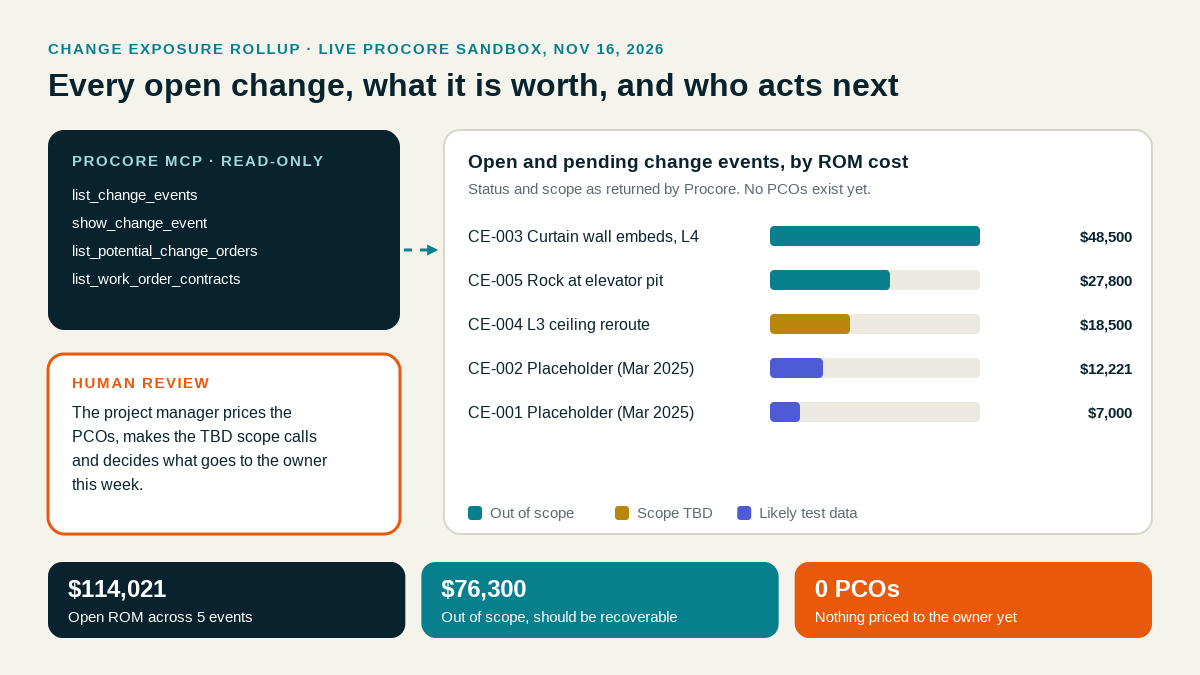 The weekly rollup on the live sandbox: one number, split by who should pay it.
Who it's for and the question it answers
Primary user: the project manager who owns change management on the job. Secondary: the project executive who signs off on the forecast, and the project accountant who has to explain the variance later.
The question: "What change exposure haven't we resolved, how old is it, how much of it should the owner pay, and what hasn't been priced or submitted yet?"
It's use case #2 in the Procore Agent Playbook catalog, scored 5 for value and 3.5 for feasibility. Value is high because unbilled or late-submitted change work is margin given away, and recovering one missed change order often pays for the whole pilot. Feasibility is lower than the RFI radar's because change data is spread across more objects and every GC configures change order tiers a bit differently.
The Procore data and the exact MCP tools
In Procore, a change event is where a potential change starts: a line per affected budget code and vendor, with a rough order of magnitude (ROM) for cost and revenue. From there it becomes potential change orders (PCOs) on the prime contract and on commitments, and eventually approved change orders. With the Change Events tool turned on, Procore creates first-tier change orders from change events, so the change event list is the right place to start counting.
These are the tools the agent called against the sandbox, as exposed by our open-source Procore MCP server with the gc_demo persona:
| Tool | What it returns | How the rollup uses it |
|---|---|---|
list_change_events | Every change event: number, title, status, scope (in scope, out of scope, TBD), created date, line items with budget code, vendor and ROM | The core list. One call returned all five events with their lines |
show_change_event | One event in full detail | Drill-down when the PM asks "what's in CE-003?" |
list_potential_change_orders | PCOs on the project | Shows what has actually been priced. On the sandbox it returned an empty list |
list_work_order_contracts | Subcontracts: number, title, status, value | Ties each change line to the subcontract it will hit |
The repo also has a change_event_manager persona and a starter workflow named change_event_rollup. That starter reads budget modifications (list_project_budget_budget_modifications), not change events, and the playbook says it plainly: there's no packaged change-exposure workflow in the repo yet, so this would be the first. The tools above are verified. The workflow is the build.
The workflow blueprint
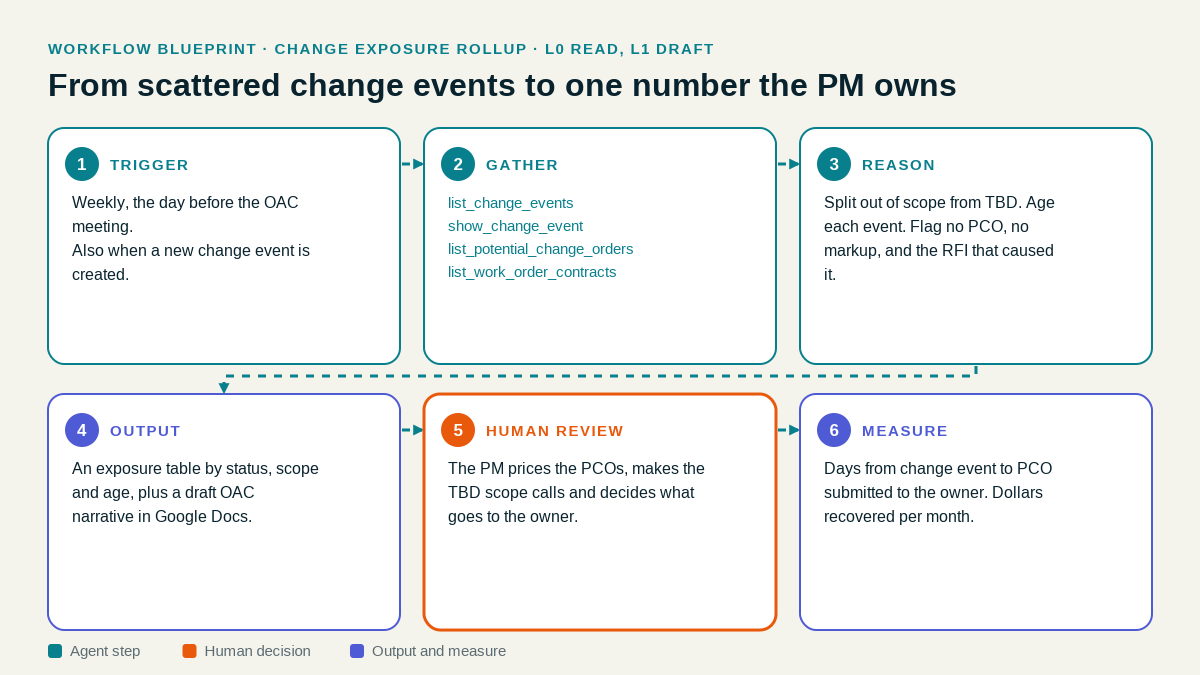 Agent steps in teal, the human decision in orange, output and measurement in indigo.
| Step | What happens |
|---|---|
| Trigger | Weekly, the day before the OAC meeting. Also when a new change event is created, so nothing sits a week before anyone sees it |
| Gather | All change events with lines, all PCOs, and the subcontract list |
| Reason | Group by status and scope. Age each event from its created date. Split out of scope (recoverable) from TBD (a decision) from in scope (our cost). Flag events with no PCO, no markup on revenue, or a linked RFI. Map each line to its subcontract and budget code |
| Output | An exposure table by status, scope and age, plus a draft OAC narrative in Google Docs |
| Human review | The PM prices the PCOs, makes the TBD scope calls and decides what goes to the owner. The agent doesn't create PCOs |
| Measure | Days from change event to PCO submitted to the owner, and dollars recovered per month |
On the write governance ladder, this is L0 read with an L1 draft (the narrative). Creating a PCO is a financial write. If you ever let an agent do it, that's a confirmed or two-person write, not a default.
Paste-ready prompts
These run in Gemini once the Procore MCP server is connected (see how to connect an MCP server in Gemini). They aren't Gemini-specific: the same questions ran in Claude Code against the same server, and any MCP client that can reach it will work.
The weekly rollup:
Use the Procore tools. Project: The Sparkling Skyrise Project. Today is 2026-11-16.

1. List every change event that is open or pending, with its line items.
2. List potential change orders on the project.
3. Build a table: CE number, title, status, scope (in / out / TBD),
   age in days, vendors and budget codes, cost ROM, revenue ROM, and whether
   a PCO exists.
4. Total the exposure three ways: out of scope (should be recoverable),
   TBD (needs a decision), in scope (our cost).
5. Flag anything over 30 days old with no PCO, any event where revenue
   ROM has no markup, and any event older than a year that looks like test data.

Read-only: do not create or change anything.
The OAC narrative:
Draft a short change management section for this week's OAC meeting from
that table. Lead with the total and what we're asking the owner to act on.
One short paragraph per event over $10,000, naming the cause (RFI, field
condition, design change) and the next step. Under 300 words. Mark anything
you are unsure of with [check].
The tie to subcontracts:
For each change event line, tell me which approved subcontract it would hit
(use the work order contracts) and whether that subcontract's cost code is
already over budget.
What it looks like on real data
We ran the rollup on a real Procore developer sandbox on November 16, 2026, against "The Sparkling Skyrise Project", a mid-rise we seeded with realistic change events, RFIs, subcontracts and a budget. The connection was read-only. Every figure here comes from the captured list_change_events and list_potential_change_orders responses. The catalog card is at 14:58 in the video, and the sandbox results are at 17:08.
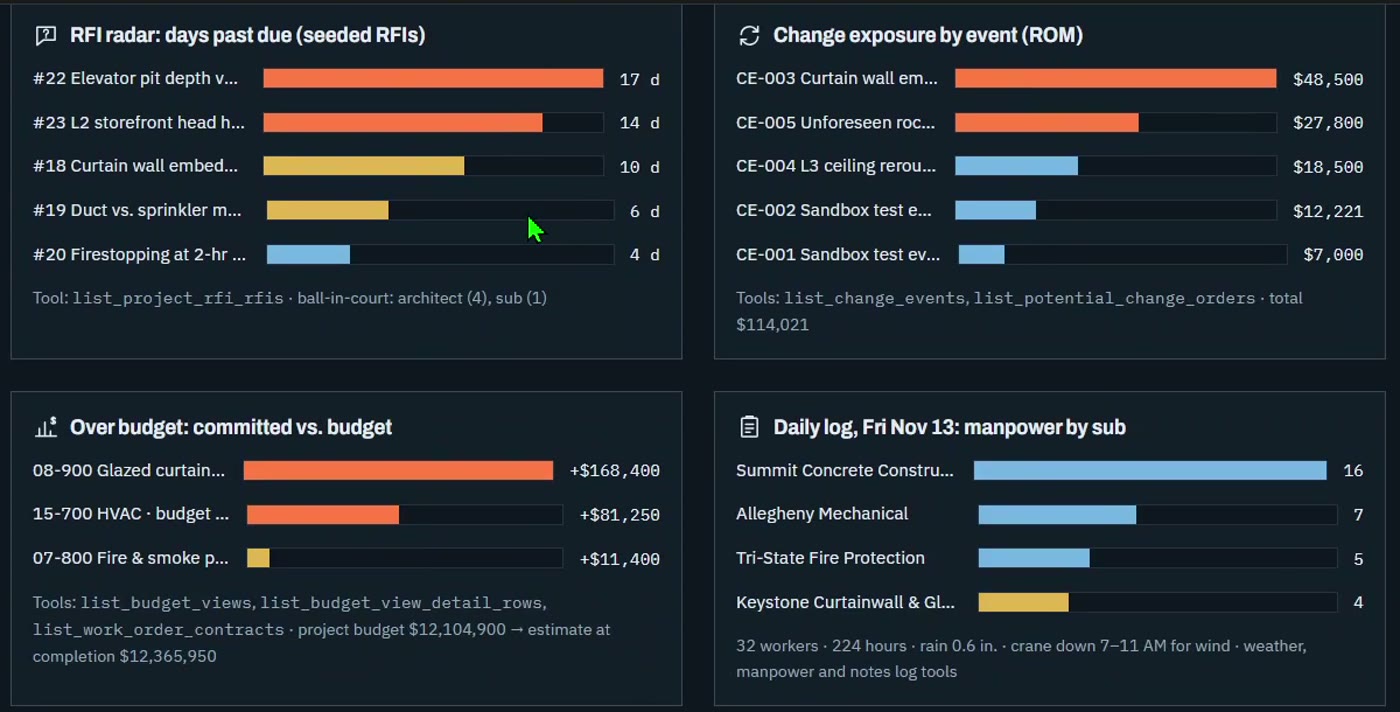 Sandbox results in the playbook. The change exposure panel is top right.
| CE | Title | Status | Scope | Lines | Cost ROM |
|---|---|---|---|---|---|
| 003 | Curtain wall embed relocation at L4 slab edge | Pending | Out of scope | Keystone $38,500 (08-900), Summit $10,000 (03-320) | $48,500 |
| 005 | Unforeseen rock at elevator pit excavation | Pending | Out of scope | Summit $27,800 (02-315), 42 CY hoe-ram | $27,800 |
| 004 | L3 corridor ceiling reroute, duct/sprinkler clash | Open | TBD | Tri-State $12,800 (15-300), Allegheny $5,700 (15-700) | $18,500 |
| 002 | "This is the Event that Changes" | Open | TBD | Test vendor | $12,221 |
| 001 | "Try to change me" | Open | TBD | Test vendor | $7,000 |
| Total | $114,021 |
What the agent said, from the captured transcript:
- All five are still at ROM. None is tied to a commitment change order, a subcontractor change order or an owner change order, and none carries markup.
list_potential_change_orderscame back empty. - The real events total $94,800. Of that, $76,300 is out of scope (CE-003 and CE-005) and should be recoverable from the owner. Get those PCOs priced and submitted.
- $18,500 is TBD (CE-004). It's a coordination clash, so someone has to decide whether it goes back to the owner or comes out of contingency.
- CE-001 and CE-002 were created in March 2025, about 610 days ago, and look like test data. Void them or confirm them.
- Revenue ROM equals cost ROM on the three real events. Add fee and markup before the PCOs go out.
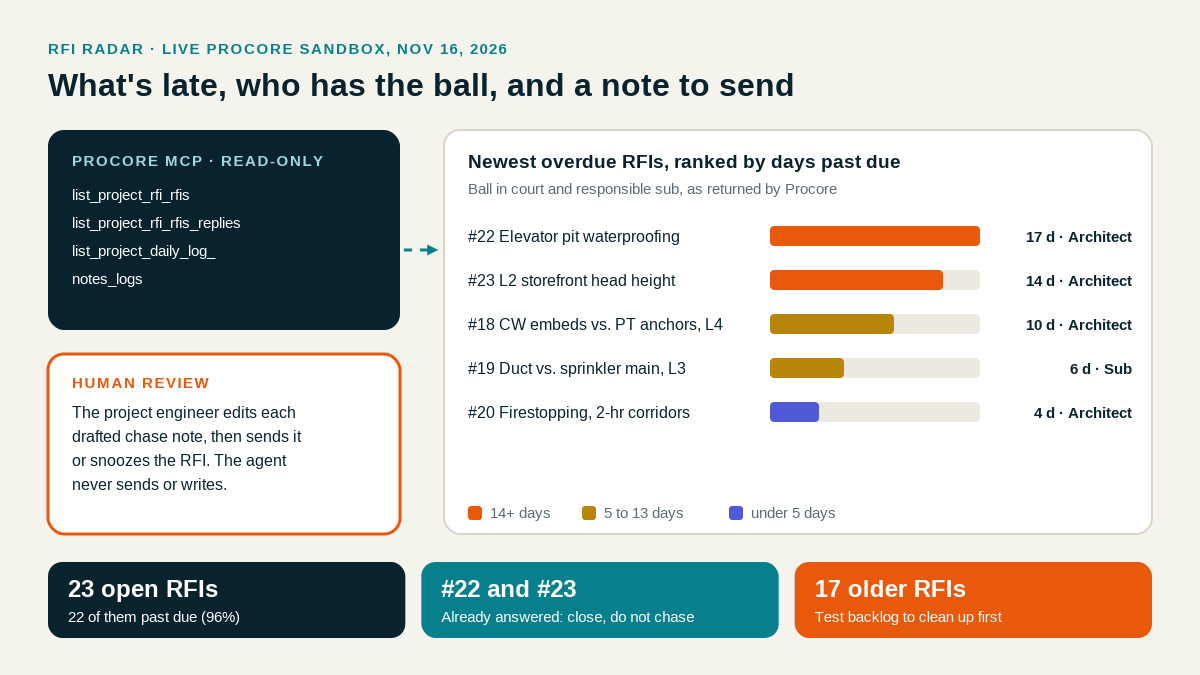
It also linked causes. CE-003 traces to RFI #18 (curtain wall embeds vs. PT anchors), which the RFI radar had at 10 days late with the curtain wall crew on hold. CE-004 describes the same duct and sprinkler clash as RFI #19, so the rollup should carry that link too. For CE-005 it suggested documenting quantities now (field-verified cubic yards, photos, the daily log) to support the differing site condition claim.
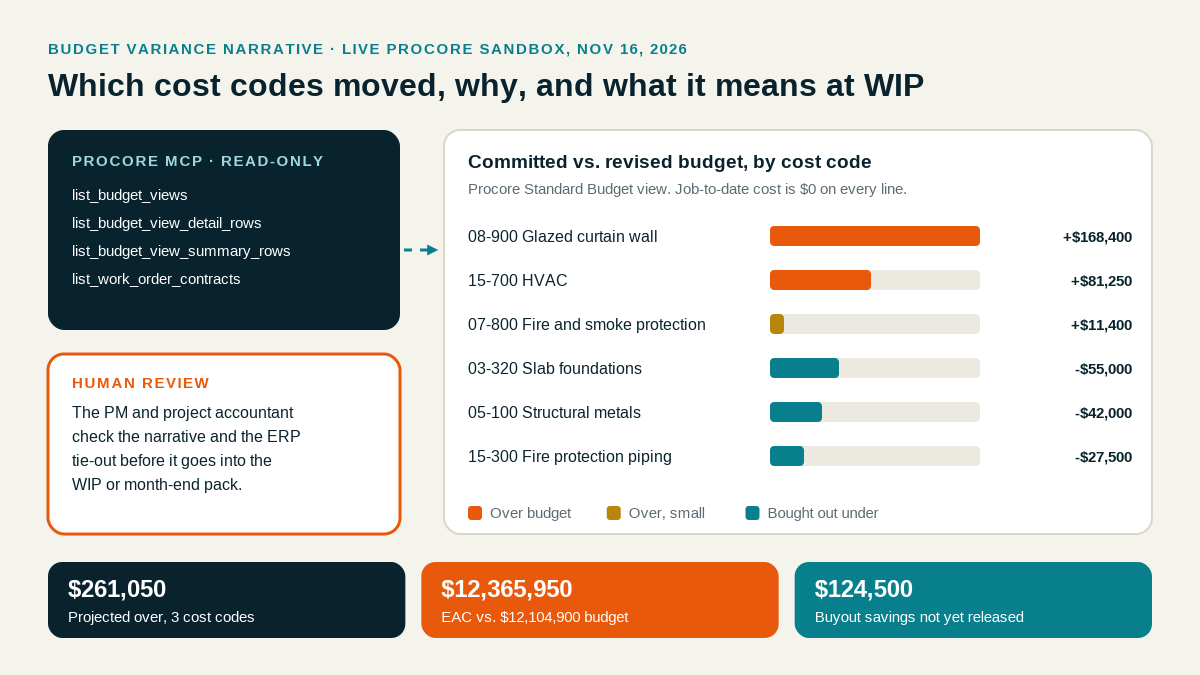
One more connection worth making. CE-003 puts $38,500 on 08-900 Glazed Curtain Wall, a cost code that the budget view already shows $168,400 over from buyout. If the owner rejects CE-003 and it lands on the GC, that line goes to $206,900 over. That's the kind of sentence a PX wants in the rollup, and it's why this agent and the budget variance narrative should read each other's output.
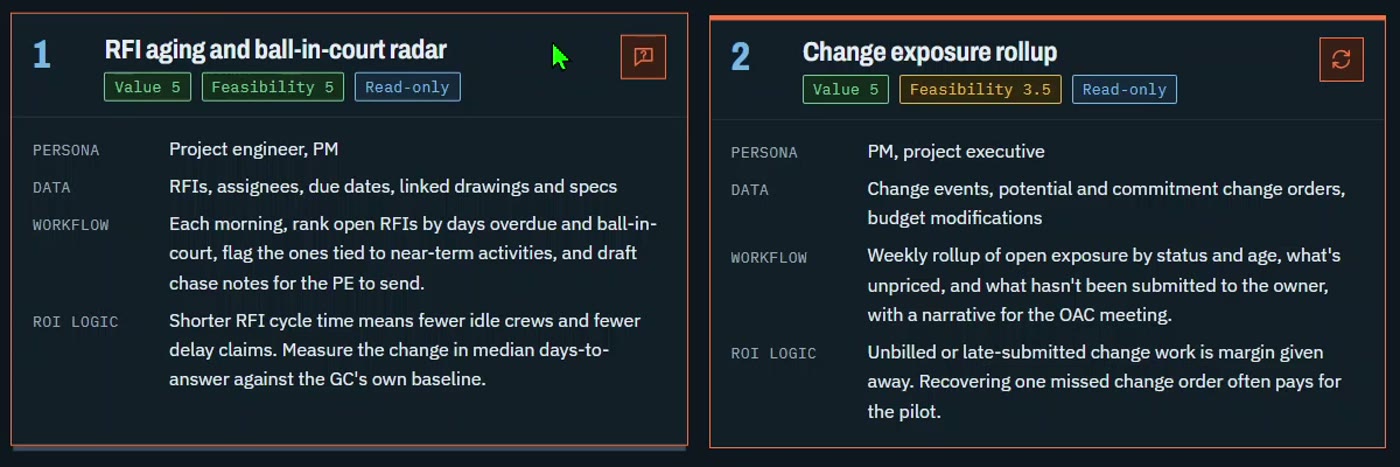 The change exposure rollup in the playbook's use-case catalog.
Edge cases and data-quality traps
- Test and placeholder events. CE-001 and CE-002 add $19,221 to the headline. Every live Procore company has some version of this: training records, duplicates, events someone meant to void. The agent should show them separately with their age, not silently drop them.
- Age that isn't real. The seeded events were created the morning of the capture, so they show an age of zero days even though the story behind them is weeks old. On live projects, check whether teams log change events when the issue appears or only when they're ready to price. Late entry hides aging, which is exactly what you're trying to measure.
- Scope set to TBD by default. Three of five events are TBD. TBD is a decision, not a category. Report it as "needs a scope call" with an owner and a date.
- Revenue ROM copied from cost. When revenue equals cost, the PCO goes out at zero margin. Flag it every time.
- Different tier setups. Procore lets a project run one, two or three change order tiers, and the setting can't be changed once change orders exist. Know the configuration before you write rules about what "submitted" means.
- Commitment vs. prime side. Cost exposure (what you'll pay subs) and revenue exposure (what the owner will pay you) need to be shown side by side. The change order aging report covers how to lay that out by job.
- ROM is not the budget. The budget view's Pending Cost Changes column was $0.00 for the whole project while $114,021 of change event ROM was open. Procore's standard budget view fills Pending Cost Changes from commitment records in pending statuses (for example, subcontracts out for signature), not from change event ROM. Don't expect the budget to show this exposure until it becomes a PCO or change order.
- Rate limits on drill-down.
show_change_eventper event is fine for five events and expensive for 300. Use the list call's lines first and only drill into the ones the PM asks about.
What to measure
| Metric | How to compute it | Target to agree |
|---|---|---|
| Change exposure age | Days from change event created to PCO submitted to the owner | The playbook suggests a 25% reduction as an example pilot target |
| Unsubmitted recoverable exposure | Out-of-scope ROM with no submitted PCO | Down every week |
| TBD exposure without a decision | TBD ROM older than 14 days | Near zero |
| Dollars recovered | Approved owner change orders traced to events the rollup flagged | Report monthly |
| Events with no markup | Count of events where revenue ROM equals cost ROM | Zero before submission |
We couldn't find a credible industry-wide figure for how much margin change orders cost GCs, so we won't quote one. Measure your own: pull the last 12 months of change events and see how many out-of-scope events never became an owner change order.
How to roll it out
- Pick one job with active changes and a PM who will use the rollup in the OAC meeting.
- Confirm the change order tier setup for that project and agree what "submitted" means.
- Connect read-only with a persona that exposes only change events, PCOs and commitments. Use a developer managed service account and the
readonly-by-defaultpolicy. - Clean the list once. Void or confirm the test events the agent flags.
- Run it the day before two OAC meetings by hand. The PM compares the rollup to their own tracker and notes every gap.
- Schedule it weekly, plus a trigger when a change event is created, delivered to the PM as a Google Doc draft.
- Add the links. Connect the rollup to the RFI radar (cause) and the budget narrative (cost code impact).
For the governance pattern behind the read-only start and the human approval step, see governing AI agents in construction and the two-phase agent workflow with human approval. For the field-to-finance view of a single change, see one construction change, field to finance. The full program starts at the pillar guide and the demo page. For how the server keeps 2,755 Procore endpoints manageable, read routing 2,755 Procore tools, and if MCP is new, what MCP means for construction.
Do it with us
BuildFlows builds the change exposure rollup with GC teams on their own Procore data: the read-only connection, the tier-aware rules, the OAC narrative template and the tie to RFIs and budget. Email charley@buildflows.ai or visit /engage.
References
- BuildFlows, Procore MCP server (open source): github.com/charley-forey/procore-mcp
- BuildFlows, Procore Agent Playbook and the video walkthrough
- Live sandbox evidence captured 2026-11-16:
list_change_events,list_potential_change_orders,list_work_order_contractsand budget view responses for project 120149 - Procore Support, Create a Commitment Potential Change Order from a Change Event: v2.support.procore.com
- Procore Support, What are the different change order tier settings in Project Financials?: v2.support.procore.com
- Procore Support, What are Procore's standard budget views? (Pending Cost Changes definition): v2.support.procore.com
- Procore Developers, Rate Limiting: procore.github.io/documentation/rate-limiting
- Google Cloud, Set up a custom MCP server for Gemini Enterprise: docs.cloud.google.com
Frequently asked questions
What is a change exposure rollup?
A weekly summary of every open or pending change event on a job, grouped by status, scope and age, showing what has been priced, what has been submitted to the owner, and how much should be recoverable. It is written for the PM and the OAC meeting.
Which Procore MCP tools does it use?
list_change_events for events and their line items, show_change_event for drill-down, list_potential_change_orders to see what has been priced, and list_work_order_contracts to tie each line to a subcontract. All are read-only.
What did it find on the Procore sandbox?
Five open or pending change events totaling $114,021 of rough order of magnitude cost. $76,300 was out of scope (curtain wall embed relocation and rock at the elevator pit), $18,500 was scope TBD, and two old placeholder events added $19,221. No potential change orders had been issued.
Why doesn't the budget show this exposure?
Procore's standard budget view fills Pending Cost Changes from commitment records in pending statuses, not from change event ROM. On the sandbox it read $0.00 while $114,021 of change event ROM was open.
Can the agent create PCOs in Procore?
Not by default. It reads and drafts. Creating a PCO is a financial write, so if you ever allow it, it should be a confirmed or two-person write with an audit trail.
Does it only work in Gemini?
No. The prompts work in Gemini once the Procore MCP server is connected, and the same questions ran in Claude Code against the same server. Any MCP client that can reach the server can use them.
Next step
Have a workflow in mind?
Start with a readiness review: the task, the data and tools it needs, the access boundaries, and how a pilot would be evaluated.
Prefer email? charley@buildflows.ai
Keep learning
Reporting & analytics · October 10, 2026
Change Order Aging: The Report That Protects Your Margin
The change order lifecycle and the four clocks worth measuring, aging buckets, pending exposure and approved-not-billed, the data problems that break aging reports, and how to track owner and subcontractor sides together.
AI agents & MCP · November 16, 2026
Procore Budget Variance and Forecast Narrative: An AI Agent for WIP Meetings
Who the budget variance narrative is for, the exact Procore MCP budget view tools it calls, the blueprint, paste-ready prompts for Gemini or any MCP client, what it found on a live Procore sandbox ($261,050 projected over across three cost codes), and the reconciliation traps.
AI agents & MCP · November 16, 2026
Procore RFI Radar: An AI Agent for Overdue RFIs and Ball-in-Court
Who the RFI radar is for, the exact Procore MCP tools it calls, the workflow blueprint, paste-ready prompts for Gemini or any MCP client, what it returned on a live Procore sandbox (23 open RFIs, 22 past due), and the data traps to plan for.