Key takeaways
- Procore's QuickBooks Online connector only retrieves job costs from lines coded to the project-specific Service items it created. Category lines, journal entries and hand-made items are not retrieved.
- The item name is [project number]-[cost code].[cost type], so 2401-03-300.M means project 2401, cost code 03-300, cost type M.
- Procore creates the items when a cost code is added to a synced project's budget. Set the project number first, use 2+ tier cost codes, and don't use QuickBooks sub-jobs.
- Never create, rename or merge these items in QuickBooks. A missing item means the budget line isn't in Procore yet, so the PM adds it there.
- An Item details line posts to the item's expense account, so re-coding a bill line can move cost between GL accounts. Check each item's account with your bookkeeper first.
- Cost type letters come from your own Procore cost type list. M, L, S, E and O are common but not fixed.
- A five-minute export of Products and services shows missing, misnamed and wrong-type items before you re-code anything.
37 seconds · From a Build Flows walkthrough
Budget codes and cost types: M, L, S, E, O
Every QuickBooks code needs a matching Procore budget code, and each item carries a cost type: M material, L labor, S subcontract, E equipment, O other.
Read the clip transcript
These are the different tables. So we'll just need to make sure that as we have the entire documentation of the cost coding for Ramp and QuickBooks, those are already aligned and mapped associated. So what we're needing to do is then map those from the Procore budget codes that we're assigning to it. And so as we're then identifying the different budget codes that are associated to the QuickBooks codes for their items, then ultimately then those will be read. And they have different item associations depending on what they're assigning it to. So they have M for material, L for labor, S for contracts, E for equipment, O for others.
Captions adapted from the source video; proper names may reflect automatic transcription. Original segment: 5:26–6:03. Watch at the source.
If you connect Procore to QuickBooks Online, your item list fills up with names like 2401-03-300.M. They look like noise, and someone on the accounting side usually wants to rename or merge them. Don't. Those service items are the only thing Procore's QuickBooks Online connector uses to place a cost on a budget line. Each name has three parts: the Procore project number, the cost code and the cost type. If you can read one, you know which job, what work and what kind of cost. And if a bill line isn't coded to one, Procore won't pick that cost up.
This guide explains where these items come from, how the name is built, which settings decide whether they exist, what happens to the GL account when you code a line to one, and how to audit your item list in a few minutes. It is part of our series on getting Ramp-paid bills into Procore, built from a job-cost plan we wrote for Ryan Blankers at Cattlemen Construction Services in Fort Worth, Texas. The section overview explains the whole fix, and you can watch the walkthrough where I go through the plan on screen.
 One item name answers which job, what work and what kind of cost
The short version
| Question | Answer |
|---|---|
| What are these items? | QuickBooks Online Service items that Procore's QuickBooks Online connector creates, one for each budgeted cost code and cost type on a synced project. |
| How is the name built? | [project number]-[cost code].[cost type], for example 2401-03-300.M. Custom WBS segments, if you use them, are inserted in the order they appear in Procore. |
| Why do they matter? | Procore's docs say job costs entered in QuickBooks must be coded to these project-specific service items to be retrieved. Lines coded to a GL account, or to items Procore didn't create, are not. |
| Who creates them? | Procore, when a cost code is added to a synced project's budget. Not you, not your bookkeeper, not an automation. |
| What breaks them? | A project number set after the budget was built, single-tier cost codes, QuickBooks sub-jobs, projects created before the connector was connected, or items typed by hand in QuickBooks. |
| What's the accounting catch? | An Item details line posts to the item's expense account. Check that account before you re-code anything. |
Why this matters for Ramp bills
Here's the problem the items solve, in one sentence. Ramp writes its coding onto the Category details section of the QuickBooks bill (a GL account like Job Materials, plus customer, class and billable), and Procore's QuickBooks Online connector only retrieves job costs from Item details lines coded to its own service items. So a Ramp-paid bill can be on the right job in QuickBooks and missing from the Procore budget. In the cases we've seen it shows as $0 on that budget line. Procore's documented symptom is that the cost isn't brought in as a direct cost, and the budget tool shows a yellow banner when it detects mis-coded job costs.
I put it this way in the video: "if something is purchased as materials for a project, well then what is the type of material then we're recording in Procore." The service item is how QuickBooks answers that question in a form Procore can read.
The fuller explanation of the two sections of a QuickBooks transaction is in QuickBooks Category details vs Item details. This guide stays on the item side.
Anatomy of a service item name
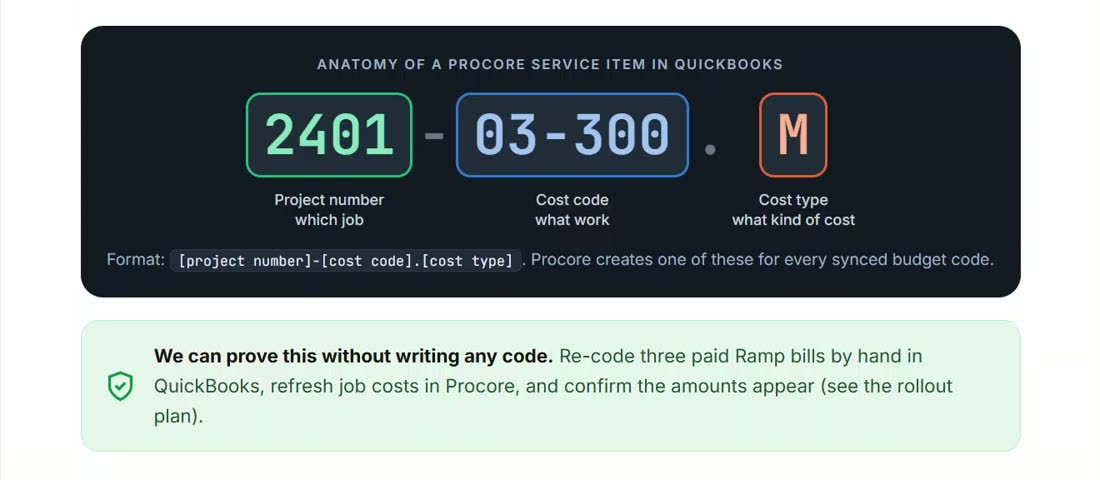 The anatomy panel from the plan, as shown in the video (illustrative data)
Take 2401-03-300.M apart:
| Part | Example | Where it comes from | What it tells you |
|---|---|---|---|
| Project number | 2401 | The Procore project's number field | Which job. On our sample data, 2401 Sample Clinic TI. |
| Separator | - | Fixed | |
| Cost code | 03-300 | The project budget line, from your company cost code list | What work. 03-300 is cast-in-place concrete. |
| Separator | . | Fixed | |
| Cost type | M | Your company's Procore cost type list | What kind of cost. M is Materials in the sample setup. |
Procore's data mapping page describes the format as [project number in Procore]-[cost code].[cost type]. Two details are easy to miss:
- If the project number is blank when the budget is built, Procore uses the QuickBooks ID in its place. You end up with items like
1187-03-300.Mthat nobody recognizes. Set the project number before adding budget lines. - The cost type letters are yours. Procore lets each company set up its own cost types. The common set is M (Materials), L (Labor), S (Subcontract), E (Equipment) and O (Other), and that's what we use in the samples here, but your list may differ. Read your own before you build anything that depends on the letters.
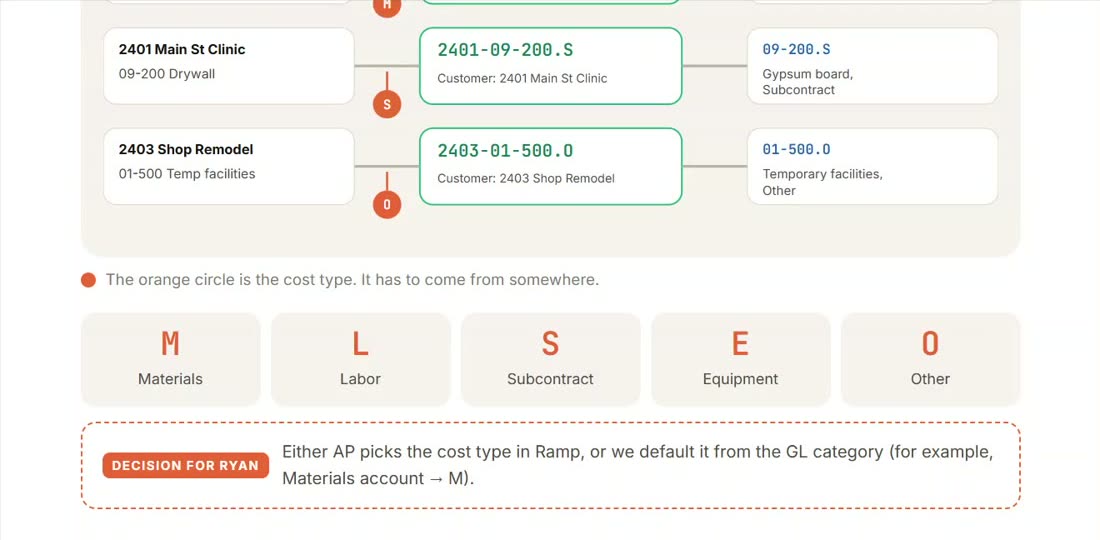 Cost types from the plan. The letters follow your own Procore setup.
Because the cost type is part of the item name, one cost code can have several items on the same project. 2401-09-200.M (drywall board the GC bought) and 2401-09-200.S (the drywall sub) are two different budget lines and two different items. That's useful for reporting, and it means anything that codes a bill line has to know the cost type as well as the cost code.
Where the items come from
 The order matters: code list, project number, budget, export
You don't make these items. Procore does, as a side effect of building a budget on a synced project. The sequence, from Procore's Things to Know and sync cost codes tutorial:
- Company cost codes. The codes have to be on the company's QuickBooks Online ERP integration standard cost code list, and they have to use two or more tiers (a division and a code, like
03-300). Single-tier codes are not supported by the connector. - A synced project. The project comes from a QuickBooks Project (QuickBooks Online Plus or Advanced, since Simple Start and Essentials don't have Projects). Sub-customers and sub-jobs are not supported. Only projects created after the connector was connected can sync.
- The project number. Set it in Procore before anyone adds a budget line, so the items are named with it.
- Budget lines. Each cost code plus cost type added to the project budget is a WBS code. Procore treats those as Service items.
- The export. A background job sends newly budgeted codes to QuickBooks Online, about every five minutes per Procore's docs. They appear in Products and services as Service items.
The reverse path is slower. Job costs come back from QuickBooks into Procore's Direct Costs and the budget's direct costs column on a once-daily background job, with an on-demand sync available. Imported direct costs arrive approved and can't be edited in Procore. Any correction happens in QuickBooks.
What this means for anything that writes bills
Two rules fall out of this, and both are in the guardrails of our plan:
- Never create a service item from QuickBooks. A hand-made item named
2401-06-100.Mis still a hand-made item. Procore didn't create it, so Procore won't read lines coded to it, and now you have a lookalike in the list. If the item you need is missing, the budget code isn't on the Procore budget yet. The fix is for the project manager to add the line in Procore and let it sync. - Edit in place, never delete and re-create. Procore can't detect deletions in QuickBooks. If a bill was imported and you delete it, the direct cost stays in Procore. Voided transactions update to $0.00. So when a bill needs re-coding, you change the lines on the existing bill.
The safe write pattern behind these rules is in safe QuickBooks write automation guardrails.
The accounting catch: which GL account gets the cost
 Re-coding a line can move the cost to a different GL account
This is the part that surprises people. A Category details line posts to the GL account it names. An Item details line posts to the expense account set on the item. So when you move a $4,850 Job Materials line onto 2401-03-300.M, the cost lands in whatever account 2401-03-300.M points at.
If the items point at the same job cost account Ramp was using, nothing changes on the P&L. If they point at a single catch-all cost account, or at different accounts by cost type, your P&L by account will shift as bills are re-coded. Neither is wrong. It just has to be a decision your bookkeeper made on purpose, before the first bill moves.
What to check:
- In QuickBooks Online, open Products and services and filter to Service items.
- Open three or four of the Procore-created items, one of each cost type, and note the expense account on each.
- Compare those accounts with the GL categories Ramp is coding to today.
- Agree with your bookkeeper where each cost type should land. If items need a different account, change it on the item in QuickBooks (and check your connector settings for any default it applies to new items). Changing an item's account doesn't rename the item, so Procore's link stays intact. Confirm that in a test company first if you're unsure.
- Run a Profit and Loss by account for the period before and after your first re-coded bill, and confirm the movement is the one you expected.
We cover this as step zero in settings to check before a Ramp, QuickBooks and Procore integration, because it's cheaper to fix in week one than after 400 bills have moved.
Audit your item list in five minutes
 What each kind of row in your item list means for Procore
Before you re-code anything, or let anyone build an automation, spend five minutes in the item list. Export Products and services to a spreadsheet and sort by name. You're looking for six things:
| What you see | What it means | What to do |
|---|---|---|
NNNN-CC-CCC.T items for every active job | Budgets are syncing | Nothing |
| An active job with no items at all | Project isn't synced, was created before the connector, or has no budget | Check the project's ERP status in Procore |
| Items starting with a number nobody recognizes | Budget built before the project number was set (QuickBooks ID used) | Fix the number in Procore for future items, and talk to Procore support about existing ones |
| Plain-English service items like "Concrete materials" | Typed by hand at some point | Leave them alone for history. Don't code job cost to them. |
| Non-inventory or inventory items used on job bills | Wrong item type for the connector | Re-code those lines to the matching service item |
| A cost code your team uses that has no item on that job | Not on the budget | PM adds the budget line in Procore |
Then do the same from the other side. Pull your list of active Procore projects and their budget codes, and check that each budget line has a matching item in QuickBooks. If the two lists agree, any bill line can be coded to a real Procore item. If they don't, fix that first, because no amount of re-coding will land a cost on a budget line that has no item.
Common mistakes
- Renaming items to something friendlier. The name is how people read the item, and it's built from Procore's data. Rename it and you lose the ability to read job, code and type at a glance. Leave Procore-created items as they are.
- Coding to the cost code without the cost type.
03-300alone isn't an item. You need2401-03-300.Mor2401-03-300.S. Decide where the cost type comes from before you start; the translation table guide covers the two options. - Using classes as the job cost key. Procore's connector doesn't write Class, and it doesn't read job cost from it. Classes can still be useful for your own reporting.
- Merging two items. Merging in QuickBooks can't be undone, and it collapses two budget lines into one from QuickBooks' side. Don't.
- Fixing it with a journal entry. Procore's docs say journal entries are not retrieved. A JE moves the cost in your books and leaves Procore unchanged.
- Assuming every Procore and QuickBooks integration works this way. This is how Procore's own QuickBooks Online connector behaves. Some third-party connectors can read category lines through a chart-of-accounts mapping. Check which one you're on.
What this has to do with Ramp
Ramp's card transactions sync to QuickBooks with category-level fields (Category, Customer, Class, Billable and so on), and its custom fields sync at the transaction level only, on Ramp Plus and above. Ramp Bill Pay can carry item lines when items are synced into Ramp, but whether that reliably reaches Procore's project-specific Service items is something we're still confirming. Ramp also launched construction job costing features in July 2026 (job, cost code and cost type coding at the card). How that coding lands in QuickBooks isn't documented yet. If you're on Ramp, ask their support the question in our pre-integration settings guide: can Bill Pay lines sync to the Procore service items in Item details? If the answer is yes, you may not need a rewrite at all.
If the answer is no, something has to translate Ramp's project and cost code into the right service item. That's the translation table, and the fastest way to prove it works is to re-code three bills by hand.
Next step
Open QuickBooks Online, go to Products and services, filter to Service items and find one Procore-created item for a job you know. Read its name out loud as job, code and type. Then open it and check its expense account. That one check tells you whether your items exist, whether they're named properly and where re-coded costs will post.
If your item list is a mess, or you want help getting Ramp bills onto the right items, email charley@buildflows.ai or tell us what you're working on.
References
- Procore Support: QuickBooks Online: Things to Know
- Procore Support: QuickBooks Online: Detailed Data Mapping
- Procore Support: Sync cost codes from Procore to QuickBooks Online
- Ramp Support: QuickBooks Online overview
- Ramp Support: Invoice line items: expense vs item
Frequently asked questions
What does an item like 2401-03-300.M mean in QuickBooks Online?
It's a Service item created by Procore's QuickBooks Online connector. 2401 is the Procore project number, 03-300 is the cost code and M is the cost type, here Materials. A bill or expense line coded to that item can be imported into Procore as a direct cost on budget code 03-300.M for project 2401.
Can I create Procore service items myself in QuickBooks?
No. Procore's connector only retrieves costs coded to service items it created. A hand-made item with the same name is still ignored. If an item is missing, add the cost code to the project budget in Procore and let it sync to QuickBooks.
Why does my Procore service item start with a number nobody recognizes?
If the Procore project number was blank when budget lines were added, Procore uses the QuickBooks ID in the item name. Set the project number before building the budget so future items are named correctly, and ask Procore support about existing ones.
Which GL account does a Procore service item post to?
An Item details line posts to the expense account set on the item, not to the category Ramp used. If that account differs from the original category, re-coding moves the cost between GL accounts. Open a few items in Products and services and confirm the account with your bookkeeper before re-coding.
Does Procore's QuickBooks Online integration support single-tier cost codes or sub-jobs?
No. Procore's documentation says cost codes need two or more tiers, such as 03-300, and QuickBooks sub-customers or sub-jobs aren't supported. Projects come from QuickBooks Projects, which need QuickBooks Online Plus or Advanced.
How often do Procore service items and job costs sync with QuickBooks Online?
Per Procore's documentation, newly budgeted cost codes export to QuickBooks as service items on a background job about every five minutes. Job costs import from QuickBooks into Procore once daily, and an on-demand sync is available.
What do the cost type letters M, L, S, E and O mean?
In a common setup they are Materials, Labor, Subcontract, Equipment and Other. Procore lets each company define its own cost types, so check your company's list before building anything that depends on the letters.
Next step
Need this connection in your environment?
Scope one integration: the records, direction, timing, and business rules behind the connection.
Prefer email? charley@buildflows.ai
Keep learning
Integrations · November 19, 2026
Why Ramp Bills Show $0 in Procore, and How to Fix It
The section hub for the Ramp to QuickBooks to Procore job-cost fix, built from the plan we wrote for Cattlemen Construction Services. Ramp writes its coding to the Category details lines of a QuickBooks Online bill. Procore's QuickBooks Online connector only retrieves job costs from lines coded to the project-specific service items it created, which live in Item details, so the cost never reaches the Procore budget. The guide shows how to confirm the gap in five minutes, then the cheapest order to fix it: check four settings, build a translation table, re-code three bills by hand to prove it, then automate with a bill line rewriter and a nightly reconciliation, with guardrails and a phased rollout.
Integrations · November 19, 2026
The Ramp to QuickBooks to Procore Translation Table: Columns, Cost Types and Confidence Rules
A guide to the translation table (crosswalk) that maps each Ramp project and cost code to the Procore-created QuickBooks service item and Procore budget code. It covers how it differs from a GL-to-cost-code mapping, the columns it needs, two rules for supplying the cost type, how most rows build from read-only calls to QuickBooks, Procore and Ramp, and how each row decides whether a bill line is rewritten, queued, escalated or left as a category line. Includes a 23-row CSV template with low-confidence and queue examples. From the job-cost plan for Cattlemen Construction Services.
Integrations · November 19, 2026
Ramp, QuickBooks Online and Procore: The Settings to Check Before You Build an Integration
The step-zero checklist from a real job-cost plan for Cattlemen Construction Services. Before anyone builds an automation to get Ramp bills into Procore job costs, confirm the Procore QuickBooks Online connector's basics (QBO Plus or Advanced, Projects not sub-customers, projects created after connection), ask Ramp whether Bill Pay lines can use the Procore-created service items, confirm 2+ tier cost codes and synced budget codes, check the budget view shows direct costs, find where the cost code lives in Ramp, check each service item's expense account, the QuickBooks closing date and the daily sync timing, and settle the owner's decision on entering invoices in Procore first.